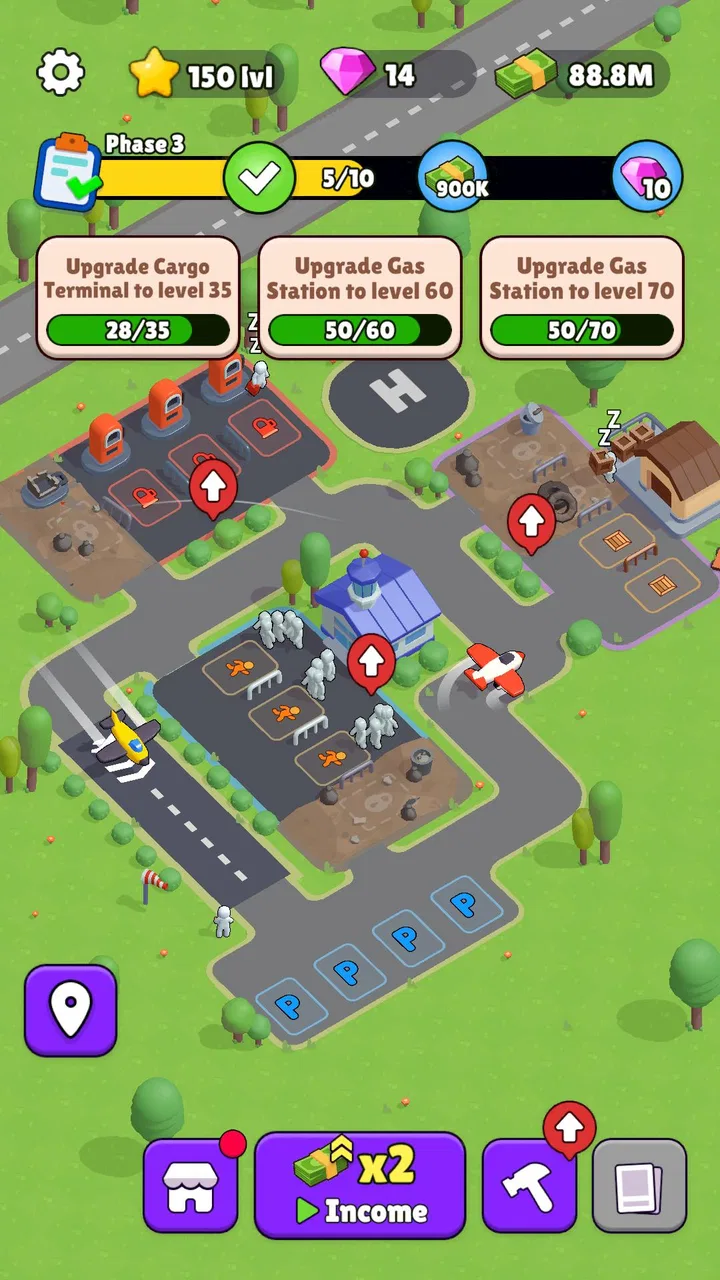
Airport Empire - Idle Tycoon
- 4.4
- Rating
- 1.00M
- Installs
- Free
- Price

 Analysis by App-foxy
Airport Empire - Idle Tycoon is the kind of simulation game I open when I want progress without committing to a long, demanding session. Its central appeal is straightforward: I develop an airport, keep its business moving, and return later to see how the operation has grown. That sounds simple, but the quality of the experience depends on how well the game turns waiting into meaningful decisions rather than empty pauses.
After spending time with it, I found that its strongest idea is the connection between idle progress and airport management. I am not constantly directing every aircraft or micromanaging every passenger. Instead, I make choices about growth, check the results, and decide what deserves attention next. That makes it approachable for casual players, although people looking for a detailed aviation simulator may find the management layer lighter than expected.
Developed by HYPERCELL, this free simulation game is available for players using Android 7.0 or later. It is rated Teen, has passed one million installs, and holds a 4.5 average from around thirteen thousand ratings. The current version is 1.0.9. Those figures suggest that the basic loop has found a sizeable audience, but the important question is whether the loop suits the way you like to play.
You May Also Like

 Blood Strike: 2.5 Anniversary
Blood Strike’s Loadouts Turn Every Drop Into a Tactical Gamble
A close look at Blood Strike’s custom loadouts: how fast access to signature weapons reshapes its battle royale rhythm, rewards preparation, and narrows the gap between fights.

 Pandora - Music & Podcasts
Pandora’s Music Is Easy to Start, but Harder to Recover
Pandora’s strength is its low-effort path from a seed to a station. Its weak spot is how much confidence it asks you to place in connection, setup, and quiet recovery.

 8 Ball Pool
 Is Built on Rivalries, Rematches, and Routine
A close look at the rivalries, rematches, shared routines, and unanswered safety questions that turn a quick pool match into a persistent mobile community.

 Samsung Music
’s Quiet Strength Is Playing What You Already Own
Its reach comes less from spectacle than from dependable access to a personal library. That simplicity is both the app’s strongest retention engine and its ceiling.

 AccuWeather: Weather Radar
AccuWeather Review: A Quick, Clear Forecast for Everyday Decisions
For everyday plans, the best forecast is the one you can understand quickly. AccuWeather makes rain timing, radar, and local conditions easy to act on, with a few trade-offs.

 Hill Climb Racing
Why Hill Climb Racing Still Turns Crashes Into One More Run
A tiny car, a bumpy hill and one more upgrade: Hill Climb Racing keeps resurfacing because its simple chaos makes every near-miss feel personal.
More From Our News Desk



Why the idle airport idea works
I like the idle airport idea because it gives small decisions room to matter: a brief visit can be about choosing what to improve, not simply keeping a game alive. In the next section, I’ll look at how that measured rhythm fits into an ordinary day, including when a quick check-in feels satisfying and when it can seem too quiet.
Progress that continues beyond each short visit
The defining capability is not simply building an airport. It is the way the airport becomes a background project. I can make a management decision, leave the game, and come back with a reason to inspect the results. That rhythm feels different from a conventional tycoon game where every minute depends on active input.
In practical terms, this makes the game fit naturally into small gaps in the day. A quick visit during a break can be enough to collect progress, review the next improvement, and set a new direction. I do not need to remember a complicated chain of actions before I can enjoy it again. The airport remains the focus, while the idle structure reduces the pressure to be constantly present.
The best part is that waiting has a purpose when I connect it to a clear goal. I may be saving toward a terminal improvement, trying to make the business more efficient, or simply expanding the airport’s ability to handle more activity. The game is more satisfying when I treat each return visit as part of a plan rather than tapping through rewards without thinking.
The useful lesson is to spend progress on a bottleneck, not just on the most visible upgrade. If one part of the airport is holding back the rest of the operation, improving that area can make later visits feel more productive. This is a small but important change in mindset: the game rewards prioritizing the flow of the business, even though it remains accessible to players who do not want a complicated spreadsheet.
Managing an airport without turning it into homework
Airport Empire presents itself as a tycoon experience, but I would place it closer to a relaxed management game than a serious economic simulation. The airport theme gives the progression a pleasant identity. Terminals, airlines, and business growth make the numbers feel connected to a place that is gradually becoming more capable.
That theme also helps the game avoid feeling like a generic idle counter. When I improve the airport, I can imagine the wider operation becoming more active and valuable. The setting gives context to the usual cycle of earning, upgrading, and returning later. It does not require specialist knowledge of aviation, which is a strength for newcomers.
At the same time, players expecting realistic airline scheduling, detailed passenger routing, or deep airport logistics should adjust their expectations. The game’s appeal comes from the simplified management loop. It asks me to think about expansion and progress, not to reproduce the work of an airport operations team.
How I approach the first stages
I get better results when I avoid spending every reward immediately. Early progress can tempt me to buy whichever improvement appears first, but holding back briefly lets me identify what is actually slowing the airport down. If earnings are growing but the next meaningful improvement is expensive, a short saving period can feel more satisfying than scattering resources across several minor choices.
I also recommend checking the airport at natural moments instead of repeatedly reopening it. The idle design is most enjoyable when it supports my schedule. Constant checking can turn a calm simulation into a repetitive routine, especially if the available action is only to collect and upgrade. A few deliberate visits are enough to keep the business moving without making the game feel like a chore.
Another practical habit is to give each session one purpose. I might focus on expanding, improving the current operation, or preparing for the next larger purchase. This keeps the interface easier to read and makes the progress feel earned. It is a simple approach, but it prevents the common idle-game problem of tapping through screens without knowing why.
How it feels in an ordinary day
What stands out in everyday use is how easily the airport can fit around other plans, provided I treat it as a gradual project rather than a task that needs constant attention. I’ll consider a realistic pattern of short visits and the point at which that convenience stops being a strength and starts to feel like repetition.
A realistic short-session scenario
Imagine opening the game during a morning commute or while waiting for an appointment. I collect the airport’s accumulated progress, look at the next upgrade, and decide whether the current earnings justify saving for it. I then leave the game and return later in the day. The second visit is not identical to the first because the airport has moved closer to a new stage of growth.
That scenario is where the game makes the most sense. I am not trying to complete a long challenge in one sitting. I am maintaining a small virtual business that develops alongside my day. The airport theme makes the return visits more enjoyable than a completely abstract idle game, while the light management keeps the mental demand low.
For a player who enjoys mobile games in short bursts, this is a comfortable arrangement. It works particularly well when I want visible progress but do not want a game that punishes me for putting the phone down. The experience is also easy to explain to someone new: build the airport, manage its growth, and come back when the business has had time to develop.
When the idle loop starts to feel thin
The same simplicity can become a limitation. If I am in the mood for a game that gives me a new tactical puzzle every few minutes, the airport may feel too quiet. The excitement comes from longer-term development rather than constant surprises. Once I understand the basic rhythm, the pleasure depends heavily on whether I enjoy watching gradual expansion.
This is also not the best choice for someone who wants a hands-on airport sandbox. A detailed simulation would normally ask me to balance many operational variables at once, while this game keeps the decisions more digestible. That makes it friendlier, but it also means that aviation enthusiasts seeking realism may prefer a more complex alternative in the simulation category.
I would also avoid treating it as a competitive strategy game unless the progression itself is enough motivation. Its strongest satisfaction comes from personal improvement and the feeling that the airport is becoming more successful. If your ideal tycoon game is built around intricate rivalries, extensive customization, or precise financial planning, this may not provide enough depth.
Free access and the spending question
The game is free to download, which makes it easy to test the core loop without making an upfront commitment. It includes in-app purchases ranging from $1.99 to $49.99 per item. That range matters because idle games naturally create moments when spending can make progress feel faster, and I think it is wise to decide your personal limit before those moments appear.
My advice is to play the airport at its natural pace first. The central appeal is seeing a business grow over time, so removing every wait can also remove part of the reason to return. A purchase may be more reasonable for someone who already knows they enjoy the game and wants convenience, but it is less useful if the underlying loop has not yet held their attention.
Parents should also keep the Teen content rating in mind when deciding whether the game is suitable for a younger player. The rating is an important part of the download decision, especially on a shared device. I would review the purchase settings as well, since a free game with optional spending is best enjoyed when the account holder remains in control of transactions.
The tradeoffs behind the airport growth
Airport growth is appealing partly because it asks for patience, but that same pacing shapes what kind of player will enjoy it. In the next section, I’ll weigh the practical tradeoffs between a relaxed, simplified tycoon loop and the deeper control or quicker action some players may prefer.
Why patience is part of the strategy
Idle progress changes how I judge an upgrade. In a traditional tycoon game, I can often work harder immediately to recover from a poor decision. Here, the passage of time is part of the loop, so an inefficient choice can make the next return visit feel less rewarding. That is why I prefer to pause and consider which improvement will support the airport’s broader growth.
This creates a gentle strategic layer without demanding complex calculations. I am not solving a full economic model, but I am still deciding whether to chase immediate comfort or prepare for a more valuable milestone. Players who enjoy delayed rewards will probably appreciate this. Players who dislike waiting may find the same design frustrating, particularly when progress slows near a desirable improvement.
A good compromise is to use short sessions for maintenance and longer sessions only when I have a clear decision to make. That keeps the idle element from dominating the experience. I also find that setting a personal goal—such as reaching the next meaningful expansion—gives the waiting period a direction and prevents the game from becoming a sequence of disconnected collections.
What the airport theme adds compared with ordinary idle games
Compared with a generic idle business game, Airport Empire gives the progression a stronger visual and imaginative frame. I am not merely increasing an anonymous balance. I am building something recognizable, and that makes each improvement easier to understand emotionally. The airport setting also gives casual players an immediate idea of what they are working toward.
Compared with a deep city-builder or management simulator, however, the experience is less demanding. Those alternatives are usually better for players who want broad planning, complex chains of production, or detailed control over every department. This game is the better fit when I want the atmosphere of running an airport without having to manage it like a professional operations system.
That middle position is the main tradeoff. It is more themed than many idle games, but less intricate than a full tycoon simulation. I see that as a deliberate strength for mobile play, provided I do not expect the title to replace a serious management simulator.
Small habits that improve the experience
- Save with a purpose: I wait for an upgrade that addresses the airport’s current limitation instead of buying every available improvement.
- Use return visits deliberately: I check in when I have a few minutes and make one clear decision, rather than repeatedly opening the game for tiny actions.
- Protect the idle appeal: I avoid paying to skip every delay before deciding whether the normal rhythm is enjoyable.
- Match the game to my mood: I choose it for steady progress, not for detailed aviation realism or constant tactical pressure.
These habits do not add hidden complexity to the game; they simply make the existing design work better. The most important is the first one. Idle games can feel directionless when rewards are spent automatically, but a modest savings plan turns the airport into a project with a visible next step.
Who gets the most from it
The best match is someone who enjoys returning to a growing airport and making occasional decisions without needing a demanding session. I’ll close by distinguishing that player from people who would get more from a detailed management simulator, a hands-on building game, or a faster-paced experience.
The ideal player
I would recommend Airport Empire - Idle Tycoon to someone who enjoys management themes but prefers a relaxed pace. It is especially suitable for players who like opening a game several times throughout the day, making a few choices, and watching a larger project develop between sessions.
It is also a good starting point for people who have never played a tycoon game. The airport setting is easy to understand, and the idle structure reduces the pressure to master a complicated system immediately. You can learn the rhythm through ordinary play rather than studying a long set of rules before the game becomes enjoyable.
The game may appeal to fans of incremental progress who want more personality than a plain number-based idle title. The airport gives the growth a clear story: investment leads to a more capable business, and each return visit checks how far that business has moved forward.
Who should choose something else
I would point aviation enthusiasts toward a deeper simulator if they want realistic airport operations. I would also suggest a more involved city-builder to players who need extensive construction freedom, layered supply chains, or constant planning. Airport Empire is not trying to be all of those things, and expecting it to deliver that level of control would make its simplicity feel like a flaw.
Players who strongly dislike timers, gradual progression, or optional purchases should also think carefully before settling in. The free entry is convenient, but the idle structure asks for patience, and the purchase range means that spending can become part of the surrounding experience. If you want a complete, uninterrupted management campaign with no temptation to accelerate progress, a paid alternative may suit you better.
Finally, this is not my first choice when I want an intense session. Its best moments arrive through accumulation and return visits, not through rapid reactions. I choose it when I want a calm airport project running in the background, not when I need a game to occupy every second of my attention.
My recommendation after living with the loop
Airport Empire - Idle Tycoon succeeds because it understands the value of a manageable commitment. I can make the airport feel more successful without turning every visit into work, and the setting gives ordinary idle progress a more memorable shape. The experience is at its strongest when I accept its pace and make each upgrade part of a simple plan.
Its limitations are just as clear. The management is intentionally approachable, so it will not satisfy everyone seeking realism or deep control. Progress can also feel less exciting when I have no specific target in mind, and the presence of in-app purchases makes it worth deciding in advance how much patience—or spending—I want to bring to the game.
For me, the deciding factor is whether the airport’s gradual growth feels rewarding. If you like short sessions, background progress, and light business decisions, this free simulation is easy to recommend. If you need complex airport logistics or nonstop action, I would skip it in favor of a more specialized alternative. For the right player, though, it offers a pleasant way to turn a few spare moments into an expanding virtual business.
FAQs for Airport Empire - Idle Tycoon
01What is the main objective of Airport Empire - Idle Tycoon?
Airport Empire - Idle Tycoon is an engaging simulation game where the main objective is to build and manage your own airport. Players start with a small terminal and gradually expand by upgrading facilities, adding new routes, and improving customer satisfaction. Your goal is to create a thriving airport empire, maximizing profits and efficiency.
02Is Airport Empire - Idle Tycoon free to play?
Yes, Airport Empire - Idle Tycoon is free to download and play. However, the game includes in-app purchases that offer additional features and upgrades. These purchases are optional and designed to enhance the gameplay experience. Players can progress through the game without spending real money, although patience and strategic planning are required.
03What kind of upgrades and features are available in the game?
The game offers a variety of upgrades and features, including expanding your terminals, adding new flights and destinations, and improving passenger amenities. Players can also invest in advanced technology to streamline operations and boost revenue. Special events and challenges provide opportunities to earn extra rewards and experience unique gameplay scenarios.
04Are there any special events or challenges in Airport Empire - Idle Tycoon?
Yes, Airport Empire - Idle Tycoon regularly features special events and challenges that provide players with the opportunity to earn exclusive rewards. These events often introduce unique gameplay mechanics and require strategic planning to complete. Participating in these events can significantly enhance your airport's growth and offer a refreshing change of pace.
05Can I play Airport Empire - Idle Tycoon offline?
While Airport Empire - Idle Tycoon does require an internet connection for some features, such as updates and social interactions, the core gameplay can be enjoyed offline. This allows players to manage and expand their airport without needing a constant internet connection, making it convenient for on-the-go play.
Pros
- Engaging gameplay with strategic elements.
- Visually appealing graphics and animations.
- Frequent updates with new features.
- User-friendly interface and controls.
- No internet connection required.
Cons
- Ads can be intrusive and frequent.
- Progression can feel slow at times.
- Limited customization options.
- In-app purchases can be pricey.
- Some tasks can be repetitive.

Airport Empire - Idle Tycoon
Gallery